- +91********12
- **********150@gmail.com

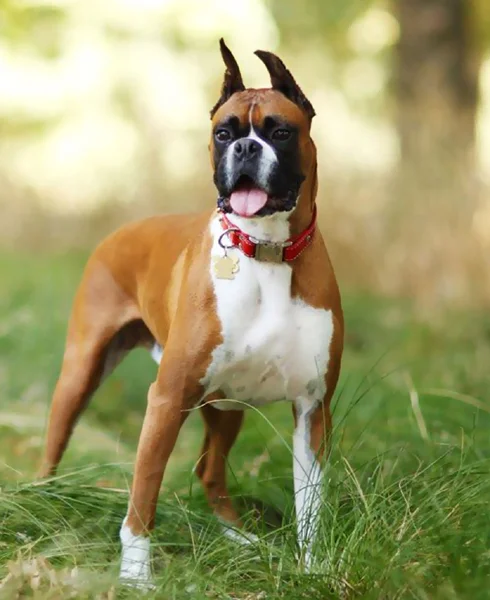
| Category | Large Dog Breeds |
The Boxer is a medium to the large, short-haired breed of dog, developed in Germany. The coat is smooth and tight-fitting; colors are fawn, brindled, or white, with or without white markings. Boxers are brachycephalic (they have broad, short skulls), have a square muzzle, mandibular prognathism (an underbite), very strong jaws, and a powerful bite ideal for hanging on to large prey. The Boxer was bred from the Old English Bulldog and the now extinct Bullenbeisser which became extinct by crossbreeding rather than by a decadence of the breed. The Boxer is part of the Molosser group. This group is a category of solidly built, large dog breeds that all descend from the same common ancestor, the large shepherd dog known as a Molossus. The Boxer is a member of the Working Group.
1.Life expectancy: 10 – 12 years
2.Origin: Germany
3.Temperament: Devoted, Friendly, Energetic, Cheerful, Intelligent, Fearless, Bright, Playful, Loyal, Confident,
4.Colors: White, Brindle, Fawn
5.Height: Female: 53–60 cm, Male: 57–63 cm
6.Weight: Female: 25–29 kg, Male: 27–32 kg
The character of the Boxer is of the greatest importance and demands the most solicitous attention. He is renowned from olden times for his great love and faithfulness to his master and household. He is harmless in the family but can be distrustful of strangers, bright and friendly of temperament at play, but brave and determined when aroused. His intelligence and willing tractability, his modesty and cleanliness make him a highly desirable family dog and cheerful companion. He is the soul of honesty and loyalty and is never false or treacherous even in his old age.
Boxers are a bright, energetic, and playful breed and tend to be very good with children. They are patient and spirited with children but also protective, making them a popular choice for families. They are active, strong dogs that require adequate exercise to prevent boredom-associated behaviors such as chewing, digging, or licking. Boxers have earned a slight reputation of being "headstrong," which can be related to inappropriate obedience training. Owing to their intelligence and working breed characteristics, training based on corrections often has limited usefulness. Boxers, like other animals, typically respond better to positive reinforcement techniques such as clicker training, an approach based on operant conditioning and behaviorism, which offers the dog an opportunity to think independently and to problem-solve. Stanley Coren's survey of obedience trainers, summarized in his book The Intelligence of Dogs, ranked Boxers at #48 – average working/obedience intelligence. Many who have worked with Boxers disagree quite strongly with Coren's survey results and maintain that a skilled trainer who uses reward-based methods will find Boxers have far above-average intelligence and working ability.
The Boxer by nature is not an aggressive or vicious breed. It is an instinctive guardian and can become very attached to its family. Like all dogs, it requires proper socialization.[better source needed] Boxers are generally patient with smaller dogs and puppies, but difficulties with larger adult dogs, especially those of the same sex, may occur. Boxers are generally more comfortable with companionship, in either human or canine form. Boxers are very patient and are great to adopt as family dogs because they are good with children and people of all kinds.


