- +91********12
- **********150@gmail.com

| Category | Large Dog Breeds |
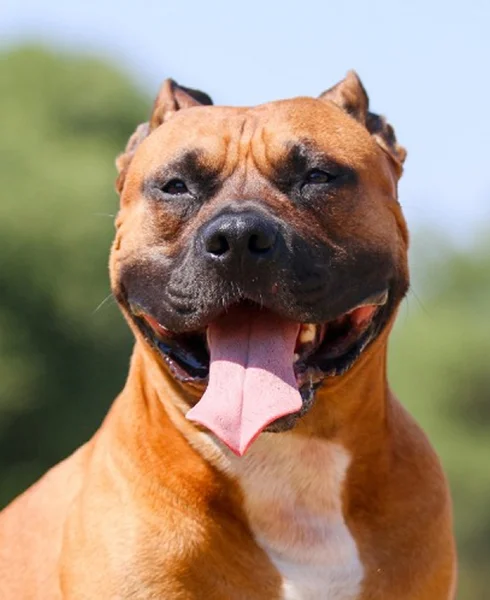
The American Pit Bull Terrier is one of the so-called bully Breeds often labeled a pit bull. In fact, "pit bull" isn't a breed, but a term used to describe the American Pit Bull Terrier, the bull terrier, the American Staffordshire Terrier, and the staffordshire Bull Terrier.
Some people say the American Pit Bull Terrier is the same as the American Staffordshire Terrier. Others, just as forcefully, say they're entirely different breeds.
But all experts can agree that the confusion started with a decision by the AKC in the early 1930s to give it a new name, American Staffordshire Terrier, to separate it from its pit-fighting past. The American Pit Bull Terrier has not been recognized by the AKC, while the American Staffordshire Terrier, which is slightly smaller, has been.
The bull breeds are often grossly misunderstood. The qualities that make these dogs tenacious players in obedience and agility games also attract highly unscrupulous people looking for strong competitors for their dog fighting rings. The sorry result is that bull breeds, in particular, the APBT has gained a reputation over recent years for being dangerous.
Nothing could be further from the through. But rampant misinformation and fear caused by the actions of a minority of dogs kept by criminally negligent people have provoked legislation against the breed in a number of cities and countries around the world.
As the owner of an American Pit Bull Terrier, you must be aware that you may be met with anger and hostility by people who are misinformed about your wonderful dog. This is not a breed for everyone, especially those who aren't willing to invest time in training and socialization and can't or won't provide consistent firm guidance.
When raised with the proper training and socialization, the American Pit Bull Terrier makes an excellent companion for children. He is loving and gentle with people and often makes a lousy guard dog because of his tail-wagging eagerness to greet the person at the door. American Pit Bull Terriers are devoted and loyal to their family and will, if necessary, defend them to the death.
These dogs are extremely intelligent and learn commands and tricks with ease. They have a zest for life and love to be involved in everything going on around them. They maintain a puppyish demeanor well into adulthood, and that vitality makes them a joy to live with. Once you have met and gotten to know this breed you will wonder how you ever lived without one.
1.Lifespan: 8 – 15 years
2.Temperament:
Clownish, Stubborn, Strong-Willed, Affectionate, Friendly, Obedient, Intelligent, Loyal,
3.Colors: Black, White, Brindle, Fawn, Tan, Grey, Blue, Brown, Red
4.Height: Male: 45 – 53 cm, Female: 43 – 50 cm
5.Mass: Male: 16 – 30 kg (Adult), Female: 14 – 27 kg (Adult)
The UKC gives this description of the characteristic of the American Pit Bulldog: "The essential characteristics of the American Pit Bull Terrier are strength, confidence, and zest for life. This breed is eager to please and brimming over with enthusiasm. APBTs make excellent family companions and have always been noted for their love of children. Because most APBTs exhibit some level of [inter]dog aggression and because of its powerful physique, the APBT requires an owner who will carefully socialize and obedience train the dog. The breed's natural agility makes it one of the most capable canine climbers so good fencing is a must for this breed. The APBT is not the best choice for a guard dog since they are extremely friendly, even with strangers. Aggressive behavior toward humans is uncharacteristic of the breed and highly undesirable. This breed does very well in performance events because of its high level of intelligence and willingness to work.
The standard imposed by the ADBA and Old Family Red Nose Registry (OFRNR) considers human aggression a disqualification factor. The American Preservation Dog Registry (APDR) standard points out that "the temperament MUST be totally reliable with people".
However, the article continued, noting that care should be taken in drawing conclusions based on these data because:
The authors concluded by noting that "breeds responsible for human DBRF have varied over time" (for example, Great Danes caused the most reported DBRF between 1979 and 1980). In the face of this inconclusive data, the study authors recommended that breed should not be the "primary factor driving public policy", instead of making the following policy recommendations: "adequate funding for animal control agencies, enforcement of existing animal control laws, and educational and policy strategies to reduce inappropriate dog and owner behaviors" as likely to be beneficial and specifically to decrease the occurrence of dog bites.
In a peer-reviewed literature review of 66 dog-bite risk studies, the american veterinary medical assocation determined that "breed is a poor sole predictor of dog bites. Controlled studies reveal no increased risk for the group blamed most often for dog bites, 'pit bull–type' dogs. Accordingly, targeting this breed or any other as a basis for dog-bite prevention is unfounded." As stated by the National Animal Control Association: "Dangerous and/or vicious animals should be labeled as such as a result of their actions or behavior and not because of their breed."
In 2014, new statistical evidence emerged regarding the province-wide ban on "pit bulls", more specifically the American Pit Bull Terrier and american staffordshire, in the Canadian province of Ontario. Since the ban had been implemented, dog bites involving pit bull types had dropped considerably as their populations decreased in the province's largest city Toronto, yet overall dog bites hit their highest levels this century in 2013 and 2014. Statistical evidence published in global news implicates several other dog breeds had contributed to the rise, stating that "Toronto's reported dog bites have been rising since 2012, and in 2013 and 2014 reached their highest levels this century, even as pit bulls and similar dogs neared local extinction."


