- +91********12
- **********150@gmail.com

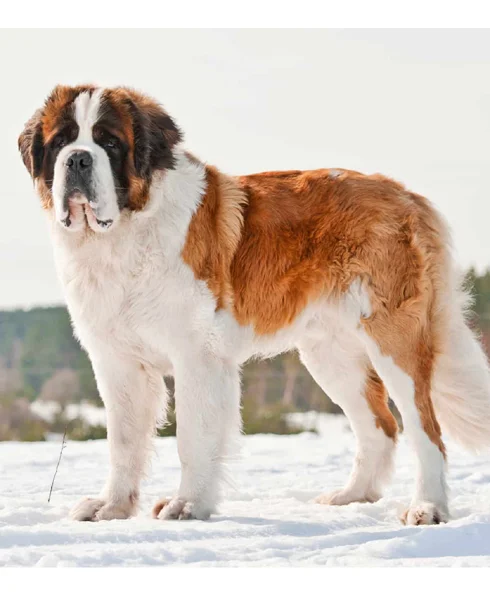
| Category | Giant Dog Breeds |
A late-night cold sufferer fills the TV screen. His night-time affliction causes him to toss and turn, each cough painful and every sneeze wracking his body. Then a deep-throated bark draws this invalid to his door, where he finds a massive dog with a flask attached to his collar. By the end of the commercial, Saint Bernard has done his job and the cold sufferer is fast asleep.
Saint Bernard did in fact rescue people from the cold, not the virus, of course, but the chill winds and snows of the Alps, so treacherous to travelers. Not surprisingly, he's a kind, gentle, intelligent, good-natured dog. He's also a giant, a large, muscular dog who can reach a height of 30 inches and a weight of 180 pounds. The Saint comes in shorthaired and longhaired varieties, the shorthaired being the one preferred by the monks of the Saint Bernard Hospice where the dogs originated.
Despite his size, Saint Bernard is a quiet indoor dog who makes a wonderful family friend. Although he's calm indoors, it's nice if he has easy access to a yard where he can have a little room to spread out. He can live in small quarters, however, as long as he gets a good daily walk. More important than the size of your home is your tolerance for mess. Saints aren't the best choice for a fastidious housekeeper. They drool and shed, and they track in mud and dirt. With this breed, saintliness is not necessarily next to cleanliness.
Saints aren't suited to living outdoors with little human companionship. They need to live in the home with their family. They're not aggressive, but they'll bark when there is a cause, and any threat to their people will bring out their protective instincts. Their size is usually a deterrent to any would-be attacker or burglar.
The easygoing Saint is gentle and patient with children if not necessarily playful. He's great to snuggle with while reading or watching television, but he can be a bit much for younger children, accidentally knocking them over with a swipe of his tail.
Saint Bernard does not need a lot of exercises. He's not a jogging companion and will wilt in hot climates. Saints suffer from heat exhaustion quite easily and need access to shade and plenty of fresh, cool water during hot weather. On the other hand, you'll never find a happier Saint Bernard than one who's enjoying a good romp in the snow.
On a sadder note, the Saint's giant size condemns him to a shorter than average canine life span. He also can suffer from a variety of genetic diseases and disorders.
Saint Bernard is a much-loved breed today. He's versatile, good-natured, and a fine choice for the person or family who would like a large but gentle dog with moderate exercise needs.
1.Life expectancy: 8 – 10 years
2.Mass: 64 – 120 kg
3.Colors: Red & White, Brownish-yellow, Reddish-brown Brindle, Reddish-brown Splash,
4.Height: Male: 70–90 cm, Female: 65–80 cm
5.Temperament: Friendly, Lively, Gentle, Watchful, Calm
6.Origin: Switzerland, Italy
Known as a classic example of a gentle giant, Saint Bernard is calm, patient, and sweet with adults, and especially children. However, Saint Bernards, like all very large dogs, must be well socialized with people and other dogs in order to prevent fearfulness and any possible aggression or territoriality. The biggest threat to small children is being accidentally knocked over by this breed's larger size. Overall they are a gentle, loyal and affectionate breed, and if socialized are very friendly. Because of its large adult size, it is essential that proper training and socialization begin while Saint Bernard is still a puppy, so as to avoid the difficulties that normally accompany training large dogs. An unruly St. Bernard may present problems for even a strong adult, so control needs to be asserted from the beginning of the dog's training. While generally not instinctively protective, a St. Bernard may bark at strangers, and their size makes them good deterrents against possible intruders.
Saint Bernard was bred to be a working companion and to this day Saint Bernard lives to please his master and is an amiable yet hard worker. Saint Bernards have retained their natural ability for scent work and depending on the skill of the trainer and the talents of the dog, St. Bernards can participate in tracking events or even become involved in search and rescue work.


